← Back to ResourcesProduct Comparisons
 View
 View
 View
View range
View range
View range
View range
 View
View
 View
View range
View range
View range
View range
Export Pallets vs Standard Plastic Pallets in New Zealand: Which Should You Choose?
By Evan Retallack, General ManagerReviewed by Matt Logan, Managing Director
Published Last reviewed 16 min read
Share:
Choosing between export pallets and standard plastic pallets affects your shipping costs, warehouse efficiency, product protection and long-term logistics expenses. Although both are manufactured from durable plastic, they are usually designed for different operational jobs.
For New Zealand’s export-driven economy — dairy, meat, horticulture, wine, seafood and forestry — an appropriately sized and weighted export pallet can improve container utilisation and reduce unnecessary transport costs. Standard plastic pallets are often better suited to warehouse storage, domestic distribution, repeated handling and pallet pooling within New Zealand.
The distinction is not always clear-cut. A heavy-duty export pallet may also suit warehousing, while a standard plastic pallet can be used for international shipping if it meets the destination’s requirements.
So what is the real difference, and which option delivers better value for a New Zealand operation?
Quick answer: Choose an export plastic pallet for one-way international freight, where light weight, container-friendly dimensions and low cost per shipment matter most. Choose a standard plastic pallet — commonly the 1200 × 1000 mm footprint for domestic and export use — for warehousing, domestic distribution and closed-loop operations where the same pallet is reused many times. Because both are plastic, both are exempt from ISPM 15 timber-treatment rules — so the decision really comes down to weight, load rating, dimensions and whether your pallets come back. This guide from Eco Pallets New Zealand explains the key differences, advantages, costs and applications to help your business make an informed purchasing decision.
What Is an Export Pallet?
An export pallet is a pallet selected or designed specifically for transporting goods from New Zealand to overseas markets.
Export pallets commonly prioritise:
- Lightweight construction to minimise shipping weight and freight cost.
- Dimensions compatible with shipping containers and destination-country handling equipment.
- Cost efficiency for one-way international shipments out of New Zealand ports such as Tauranga and Auckland.
- Suitable load-bearing capacity for the intended cargo.
- Resistance to moisture and the environmental conditions encountered during sea freight.
- Straightforward compliance with relevant international packaging requirements.
Plastic export pallets are particularly attractive because they are not subject to the ISPM 15 treatment and marking requirements that apply to timber packaging leaving New Zealand. Unlike wooden pallets, plastic pallets do not require heat treatment or fumigation solely to comply with that standard. Exporters must still meet applicable destination-country import, cleanliness, cargo and packaging requirements.
Examples of Plastic Export Pallets
Eco Pallets New Zealand — with local stock held at our Auckland warehouse — supplies a range of plastic export pallets suited to different freight requirements.
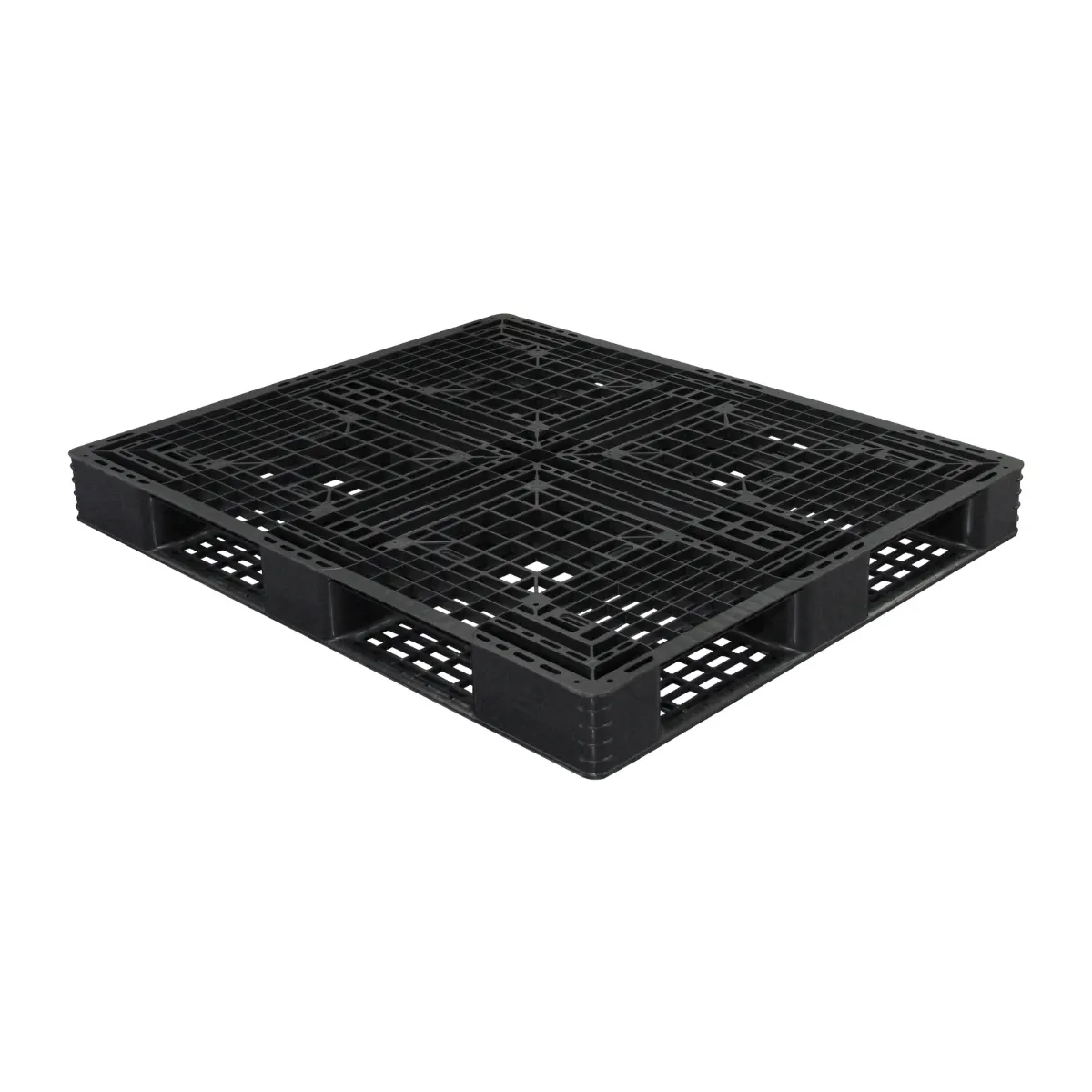
1. A versatile export pallet built around a footprint widely used both within New Zealand and across international Asia-Pacific trade, well suited to businesses exporting manufactured goods, packaged products and general commercial cargo.
Plastic Pallet for International Export
Plastic Export Pallet – 1200 x 1000mm
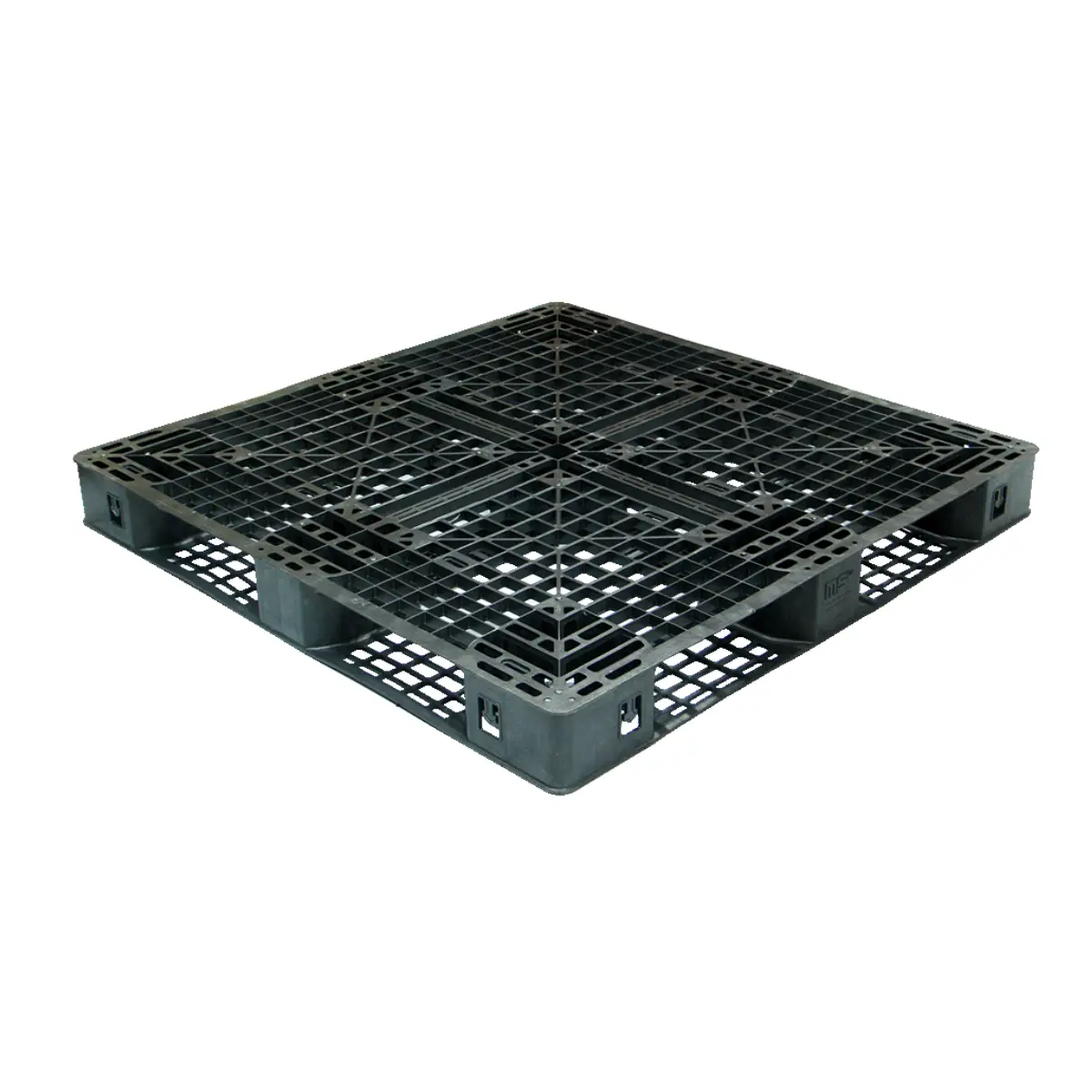
2. Container-Optimised Export Pallet — 1140 × 1140mm. The square 1140 × 1140mm footprint is designed to improve space utilisation in suitable shipping-container configurations — useful for exporters moving palletised bulk goods where container-floor efficiency drives landed cost.
Plastic Pallet for International Shipping
Container-Optimised Export Pallet – 1140 x 1140mm
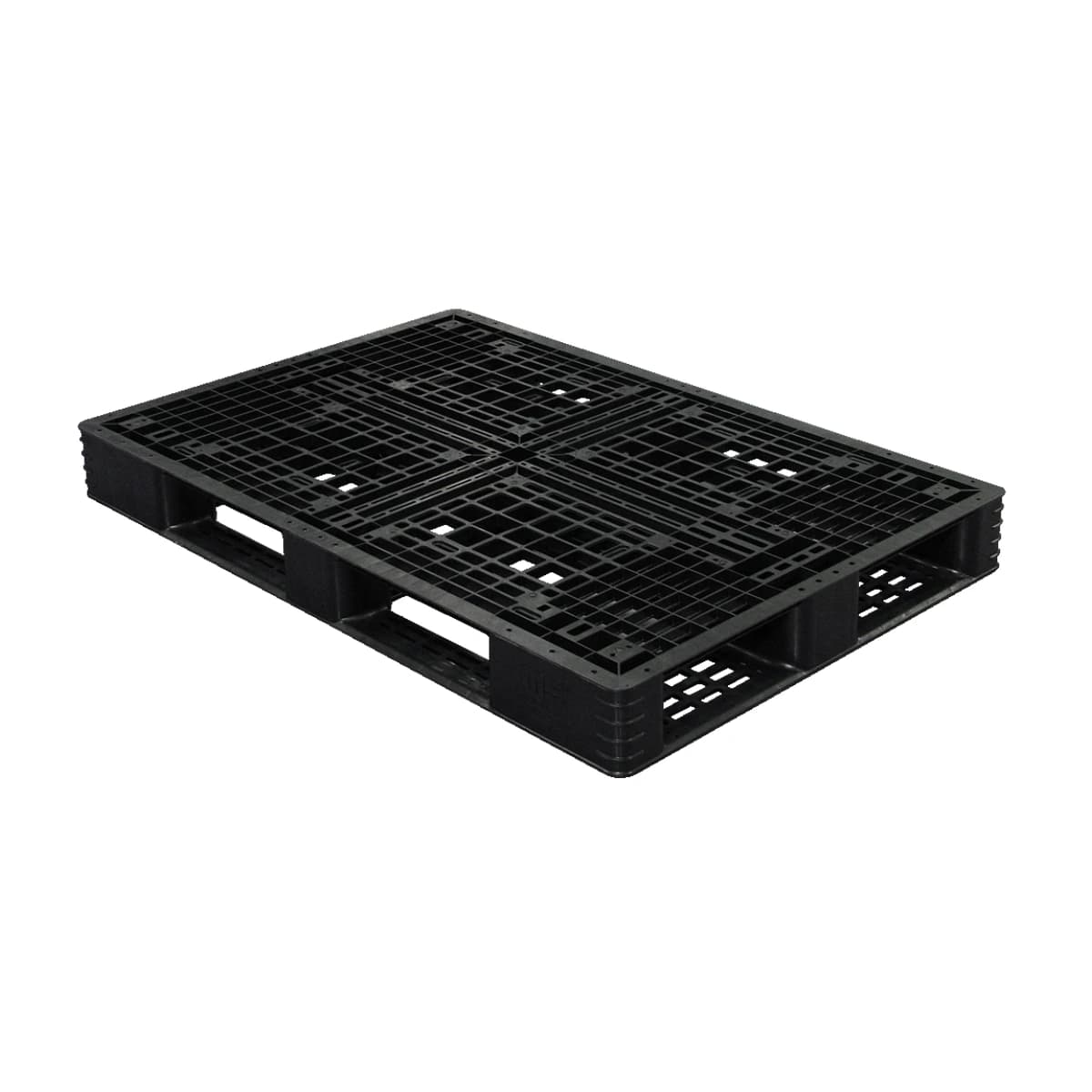
3. Euro Plastic Export Pallet — 1200 × 800mm. A practical option for New Zealand businesses supplying European markets that use Euro-sized handling and storage infrastructure. The 1200 × 800mm footprint helps reduce compatibility issues with European customers.
Euro Export Pallet
Euro Plastic Export Pallet – 1200 x 800mm
Explore the complete export range
Series · 5 products
Export Plastic Pallets
What Is a Standard Plastic Pallet?
A standard plastic pallet is a general-purpose pallet designed to support, store, handle and transport goods within warehouses and distribution networks.
New Zealand does not mandate a single national pallet size. In practice, the 1200 × 1000 mm footprint is widely used for domestic and export freight, while the Australian Standard 1165 × 1165 mm is also common because of the close trans-Tasman trade relationship with Australia. The term “standard plastic pallet” covers a range of designs and duty ratings rather than one universal product:
- Light-duty pallets for relatively lightweight goods.
- Heavy-duty pallets for demanding industrial operations.
- Rackable pallets engineered for supported use in pallet racking.
- Automated-warehousing pallets built for shuttle and drive-in racking systems.
- Nestable pallets designed to save storage space when empty.
Many standard plastic pallets are built for repeated use over extended periods. For businesses operating closed-loop distribution between New Zealand sites — where pallets are returned and reused — a durable standard plastic pallet may offer better long-term value than a lightweight one-way export pallet.
Examples of Standard Plastic Pallets
1. Light-Duty Plastic Pallets. For applications where low pallet weight and economical handling are priorities, such as retail distribution, light warehouse storage and lower-weight goods movements.
Series · 2 products
Light Duty Plastic Pallets
2. Heavy-Duty Plastic Pallets. Built for heavier loads and more demanding handling — including rackable designs for New Zealand warehousing. For example, the Rackable Automated Warehousing Pallet — 1200 × 1200mm suits demanding storage and racking.
Series · 3 products
Heavy-Duty Plastic Pallets
3. Automated Warehousing Pallets. Steel/metal-reinforced plastic pallets engineered for shuttle and drive-in racking in automated facilities, such as the Metal-Reinforced Automated Warehousing Pallet — 1200 × 1200 × 160mm.
Explore the full range
Series · 3 products
Automated Warehousing
Export Pallets vs Standard Plastic Pallets: Key Differences
Understanding the differences between the two categories is essential when selecting pallets for an efficient New Zealand supply chain.
| Feature | Export Plastic Pallets | Standard Plastic Pallets |
| Primary application | International freight and export logistics | Domestic warehousing, interstate transport and repeated distribution |
| Typical design priority | Freight efficiency, suitable dimensions and cargo protection | Durability, handling compatibility and repeated use |
| Pallet weight | Often lightweight | Varies from lightweight to heavy-duty |
| Load capacity | Varies; heavy-duty export options available | Varies according to pallet design |
| ISPM 15 requirements | Plastic Pallets are exempt | Also exempt |
| Common dimensions | 1200 × 1000mm, 1100 × 1100mm, 1140 × 1140mm, 1200 × 800mm | 1200 × 1000mm (NZ) and 1165 × 1165mm (trans-Tasman) |
| Reusability | One-way and reusable options | Often selected for repeated handling |
| Racking suitability | Only where specifically rated | Only where specifically rated |
| Best buying consideration | Total cost per export shipment | Total cost over the pallet’s service life |
Important: These are general comparisons, not universal specifications. Individual pallet models should always be evaluated against their published static, dynamic and racking load capacities.
1. Weight and International Freight Costs
Pallet weight can influence transport costs, particularly when shipping large volumes of goods. An export pallet designed for lightweight construction may reduce the total weight of a consignment compared with a heavier industrial pallet, which can help when freight charges are driven by gross shipment weight.
For example, replacing a 20kg pallet with a 10kg pallet across 500 shipments would reduce total pallet weight by:
500 pallets × 10kg saved = 5,000kg
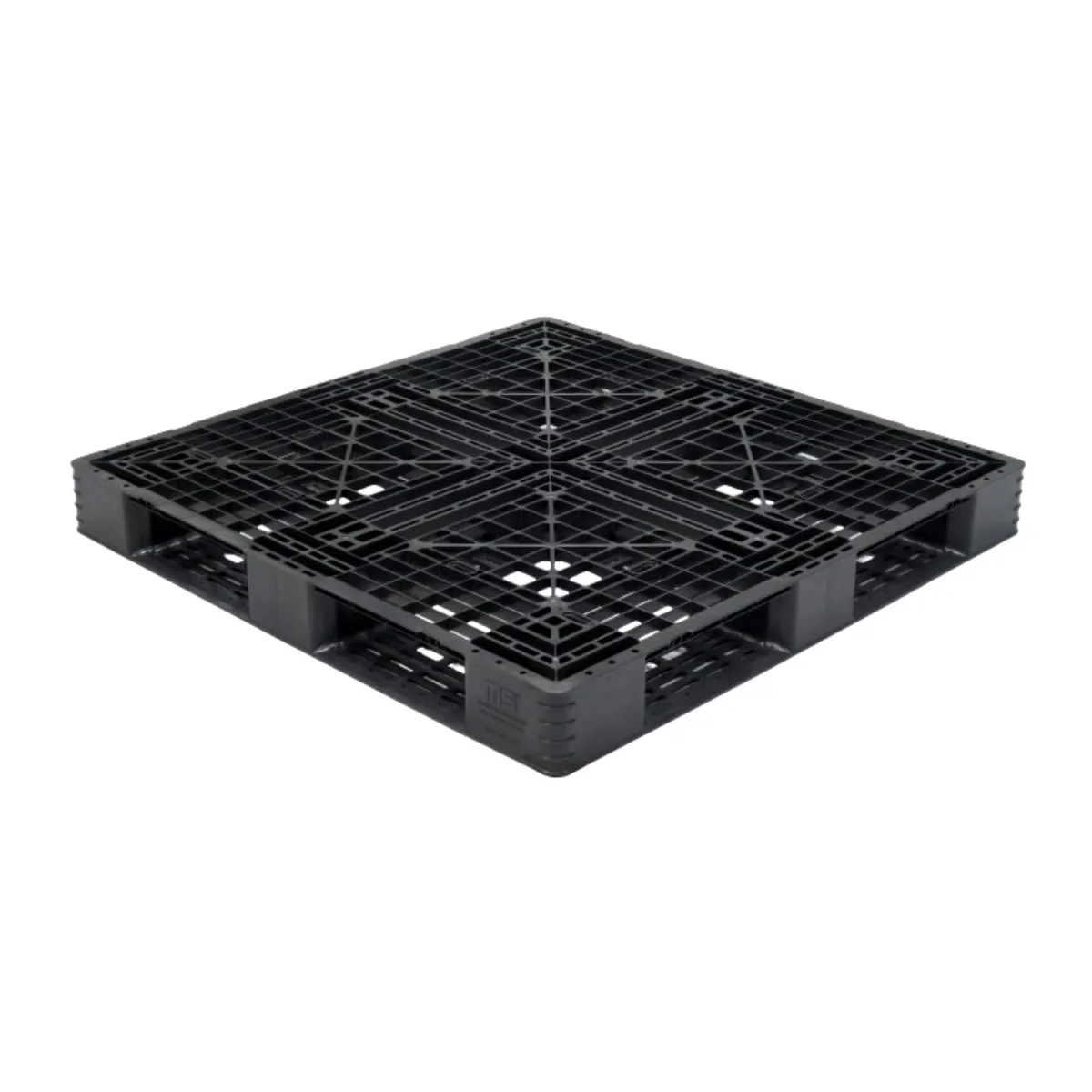
That is five tonnes less pallet weight transported across those shipments. The actual saving depends on freight pricing, container weight limits and whether weight or volume is the limiting factor — for volume-constrained shipments, lighter pallets may deliver little direct freight saving.Recommended product: the Plastic Export Pallet — 1100 × 1100mm is designed for general international freight where a lightweight square-footprint pallet is suitable.
Square Export Pallet
Plastic Export Pallet – 1100 x 1100mm
2. Load Capacity and Structural Strength
One of the most important considerations when selecting any plastic pallet is its load-bearing capacity. Pallet load ratings are One of the most important considerations when selecting any plastic pallet is its load-bearing capacity. Pallet load ratings are generally described using three categories, which are not interchangeable:
- Static load capacity — the maximum permissible load when a pallet is stationary and adequately supported.
- Dynamic load capacity — the permissible load while the pallet is being moved using appropriate handling equipment.
- Racking load capacity — the permissible load when the pallet is supported by an approved racking configuration.
For example, a pallet rated to 4,000kg statically does not necessarily support 4,000kg during forklift movement or in beam racking.
Are Export Pallets Weaker Than Standard Pallets?
Not necessarily. Although many export pallets prioritise lightweight construction, reinforced and heavy-duty plastic pallets are built for heavier or rackable loads. Eco Pallets New Zealand’s metal-reinforced automated-warehousing pallets, for example, include added structural reinforcement for demanding storage and handling environments. Always compare the published static, dynamic and racking ratings for the specific model rather than assuming an export pallet is a light-duty product.
3. ISPM 15 Requirements and Exporting from New Zealand
A major benefit of plastic pallets is their exemption from ISPM 15 wood-packaging treatment and marking requirements.
What is ISPM 15? ISPM 15 is an international phytosanitary standard developed under the International Plant Protection Convention. It addresses the risk of transporting pests through raw wood packaging used in international trade. In New Zealand, biosecurity and export phytosanitary requirements are administered by the Ministry for Primary Industries (MPI) / Biosecurity New Zealand — compliant timber packaging generally requires approved treatment and marking.
Do plastic export pallets require ISPM 15 certification? No. Plastic pallets are not subject to ISPM 15 wood-packaging treatment and marking requirements — this applies to both export-specific plastic pallets and standard plastic pallets. Exporters using plastic pallets therefore avoid the wood-treatment and marking procedures associated with ISPM 15. Plastic pallets are not automatically exempt from every biosecurity or import requirement, so exporters should still verify the rules applicable to their cargo and destination country with MPI and the receiving country’s authority.
4. Pallet Dimensions and Shipping Container Efficiency
Pallet dimensions influence how efficiently goods fit inside a shipping container. A poorly matched footprint can create unused floor space, reduce loading flexibility or increase handling difficulty.
| Pallet dimensions | Typical consideration |
| 1200 × 1000mm | Widely used New Zealand domestic and international export footprint |
| 1100 × 1100mm | Square footprint used across various Asian logistics applications |
| 1140 × 1140mm | Container-focused square configuration for floor-space efficiency |
| 1200 × 800mm | Euro-sized pallet for compatible European supply chains |
| 1165 × 1165mm | Australian Standard footprint for trans-Tasman trade |
There is no single best pallet dimension for every export shipment. The ideal choice depends on the destination, cargo footprint, container type, loading arrangement and receiving equipment.
Why container-optimised pallets matter. Businesses shipping full container loads should consider more than the cost of an individual pallet — a footprint that enables better container utilisation can reduce the number of containers needed over time. Container-floor calculations should still account for loading clearances, cargo overhang, securing requirements and operational constraints. For suitable applications, Eco Pallets offers the 1140 × 1140mm Container-Optimised Export Pallet.
Container Optimised Shipping Pallet
Container-Optimised Export Pallet – 1140 x 1140mm
5. Durability and Reusability
Standard plastic pallets are often selected for New Zealand distribution operations involving frequent handling and repeated movements. A manufacturer operating between a production facility and a distribution warehouse, for instance, may reuse the same pallets many times, so a more durable pallet can reduce the long-term cost per use.
Businesses shipping goods internationally without receiving empty pallets back may instead prioritise economical one-way export pallets. This does not make export pallets disposable — some are designed for repeated use, and some standard pallets suit one-way freight. The appropriate selection depends on expected handling cycles, load requirements and the economics of recovering empty pallets.
6. Nestable Pallets and Storage Efficiency
Nestable plastic pallets are designed so that empty pallets partially fit inside one another, reducing the space needed to store and transport empties. For businesses frequently moving empty pallets between New Zealand facilities, nestable designs can be particularly beneficial.
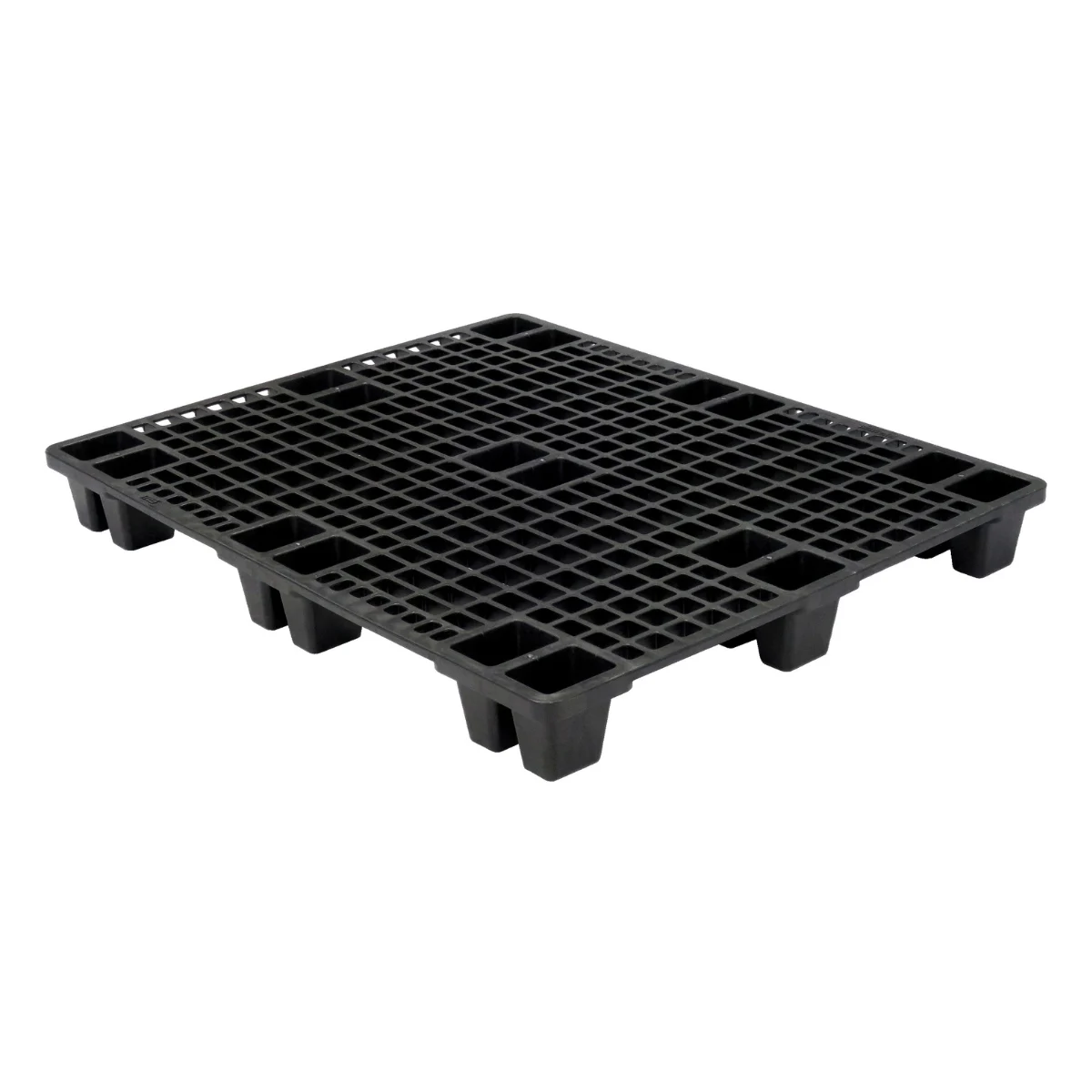
Eco Pallets offers the Nestable Plastic Export Pallet — 1200 × 1000mm (model Eco-1210SL 9LEG), featuring a nine-leg configuration intended to reduce empty-pallet storage requirements and improve return-freight efficiency.
Nestable Pallet for International Shipping
Nestable Plastic Export Pallet – 1200 x 1000mm
Nestable pallets are especially worth considering when:
- Empty-pallet storage space is limited.
- Return-freight costs are significant.
- Large quantities of pallets are handled.
- The cargo and handling equipment are compatible with the nestable design.
7. Which Pallet Is More Cost-Effective?
The answer depends on how the pallet will be used.
For one-way international shipping, an economical export pallet may be the better choice. Key considerations: initial pallet price, freight weight, container utilisation, destination compatibility and cargo-protection requirements.
For repeated domestic operations, a reusable standard plastic pallet may deliver better long-term value. Key considerations: purchase price, expected service life, handling frequency, damage and replacement costs, equipment compatibility, and storage and retrieval requirements.
Consider total cost of ownership. Evaluate more than the initial purchase price:
- For a reusable pallet: Cost per use = total pallet ownership cost ÷ number of successful uses.
- For an export pallet: Total shipment cost = pallet purchase cost + pallet-related freight and handling costs + any other applicable pallet-related expenses.
The cheapest pallet to purchase is not necessarily the cheapest pallet to operate.
8. Which New Zealand Industries Benefit Most?
- Exporters and freight forwarders — lightweight, appropriately sized export pallets may improve international shipping efficiency out of New Zealand ports.
- Primary industries (dairy, meat, horticulture, wine, seafood) — export pallets support high-volume outbound freight, while hygiene-appropriate pallets suit food and beverage supply chains.
- Forestry and manufacturing — heavy-duty and reinforced plastic pallets may be required for dense materials, industrial components and demanding transport conditions.
- Trans-Tasman traders — businesses shipping to Australia should confirm whether their customer uses the Australian Standard 1165 × 1165 mm or the 1200 × 1000 mm footprint for compatibility with Australian racking and handling.
- Retail and distribution centres — reusable plastic pallets help standardise handling and improve compatibility with domestic warehouse processes.
In each case, the best choice is determined by the cargo, operating environment, handling equipment and total logistics requirements.
How to Choose the Right Plastic Pallet: A Practical Checklist
Before purchasing plastic pallets, work through these questions:
- Domestic, trans-Tasman or international use? For overseas shipments, confirm destination requirements; for trans-Tasman freight, confirm your Australian customer’s footprint; for domestic use, the 1200 × 1000 mm footprint is widely compatible.
- What is the maximum cargo weight? Check the manufacturer’s published static and dynamic load ratings.
- Will the pallet go into warehouse racking? Only use pallets rated for the exact intended racking arrangement and load.
- One-way or returnable shipment? For one-way exports, weigh purchase cost and freight efficiency; for returnable applications, weigh durability and cost per use.
- What dimensions does the receiving customer require? Confirm compatibility before ordering.
- Will the pallet carry food, chemicals or other regulated products? Verify material and application requirements rather than assuming every plastic pallet has the same properties or approvals.
- How will empty pallets be stored? Consider nestable designs where empty-pallet space or return freight is a significant cost.
Final Verdict: Export Pallets or Standard Plastic Pallets?
The best pallet is the one that matches your logistics requirements while delivering the right balance of cost, performance and operational efficiency.
Choose an export plastic pallet when:
- You regularly transport goods internationally from New Zealand.
- Minimising pallet weight is commercially beneficial.
- You require a particular international pallet footprint.
- Container utilisation is a priority.
- You need an economical solution for one-way freight.
Choose a standard plastic pallet when:
- You operate a domestic warehouse or distribution network.
- Pallets will be reused frequently.
- Long-term durability is a purchasing priority.
- You require a specific warehouse-handling or racking configuration.
- You ship trans-Tasman and need Australian-compatible handling.
For some businesses, a heavy-duty export pallet or versatile rackable plastic pallet provides the benefits of both categories.
Find the Right Plastic Pallet with Eco Pallets New Zealand
At Eco Pallets, we understand that selecting the right pallet involves more than comparing dimensions and purchase prices. Whether you need lightweight pallets for international shipments, container-optimised export pallets or durable plastic pallets for everyday warehousing, our range — with local stock at our Auckland warehouse — supports a wide variety of industrial and commercial applications across New Zealand.
Explore our ranges
Series · 5 products
Export Plastic Pallets
Series · 2 products
Light Duty Plastic Pallets
Series · 3 products
Automated Warehousing
Series · 3 products
Heavy-Duty Plastic Pallets
Request a wholesale quotation today and let Eco Pallets help you identify a plastic pallet solution suited to your freight, storage and material-handling requirements across New Zealand.
Frequently Asked Questions
Export pallets are chosen primarily for international freight, prioritising light weight, container-compatible dimensions and low cost per one-way shipment. Standard plastic pallets are built for warehousing, domestic distribution and repeated handling. The categories overlap — a heavy-duty export pallet can be reused, and a durable standard pallet can ship internationally — so the right choice depends on your load, dimensions and whether pallets come back.
New Zealand does not mandate a single national pallet size. The 1200 × 1000 mm footprint is widely used for both domestic and export freight, while the Australian Standard 1165 × 1165 mm is also common because of trans-Tasman trade with Australia. Match the footprint to your customers’ handling equipment and your main freight lanes.
No. ISPM 15 applies to solid-timber packaging, not plastic, so every plastic pallet — export or standard — sits outside its heat-treatment, fumigation and marking requirements. In New Zealand, biosecurity and export requirements are administered by the Ministry for Primary Industries (MPI); plastic pallets avoid the ISPM 15 timber process, though you should still confirm any other biosecurity or import rules for your cargo and destination.
For trans-Tasman freight, confirm whether your Australian customer uses the Australian Standard 1165 × 1165 mm or the 1200 × 1000 mm footprint, as both are common in Australia. The widely compatible 1200 × 1000 mm export pallet is a practical option, and as a plastic pallet it is ISPM 15 exempt. Confirm your customer’s specific pallet and handling requirements before ordering.
Not necessarily. Many export pallets are lightweight to save freight, but that is a design priority, not a sign of lower quality — reinforced and heavy-duty plastic pallets are available for demanding or rackable loads. Always compare the published static, dynamic and racking ratings of the specific model rather than judging strength by weight or appearance.
Often, yes. A heavy-duty or rackable plastic pallet can handle warehouse racking and still be shipped internationally, which suits businesses wanting to standardise on a single pallet. The compromise is weight: a dual-purpose pallet is heavier than a dedicated lightweight export pallet, so if most of your volume is one-way export, running separate export and warehouse pallets usually costs less overall.
For one-way international shipments, an economical export pallet usually wins on total shipment cost (purchase price plus freight weight and handling). For repeated, closed-loop use, a durable standard pallet usually wins on cost per use over its service life. The cheapest pallet to buy is rarely the cheapest to operate, so compare per-shipment cost against lifetime cost per use for your actual handling pattern.
A nestable export pallet such as the Eco-1210SL 9LEG is worth it when empty-pallet storage space is tight, return-freight costs are significant, or you handle large pallet volumes — its nine-leg design lets empties nest to cut storage and return-transport space. Confirm your cargo and handling equipment suit a nestable design before standardising on it.
Found this useful? Share it.
Share:
Ready to Get a Quote?
Speak with our commercial team for wholesale pricing and product recommendations.
Request a Quote